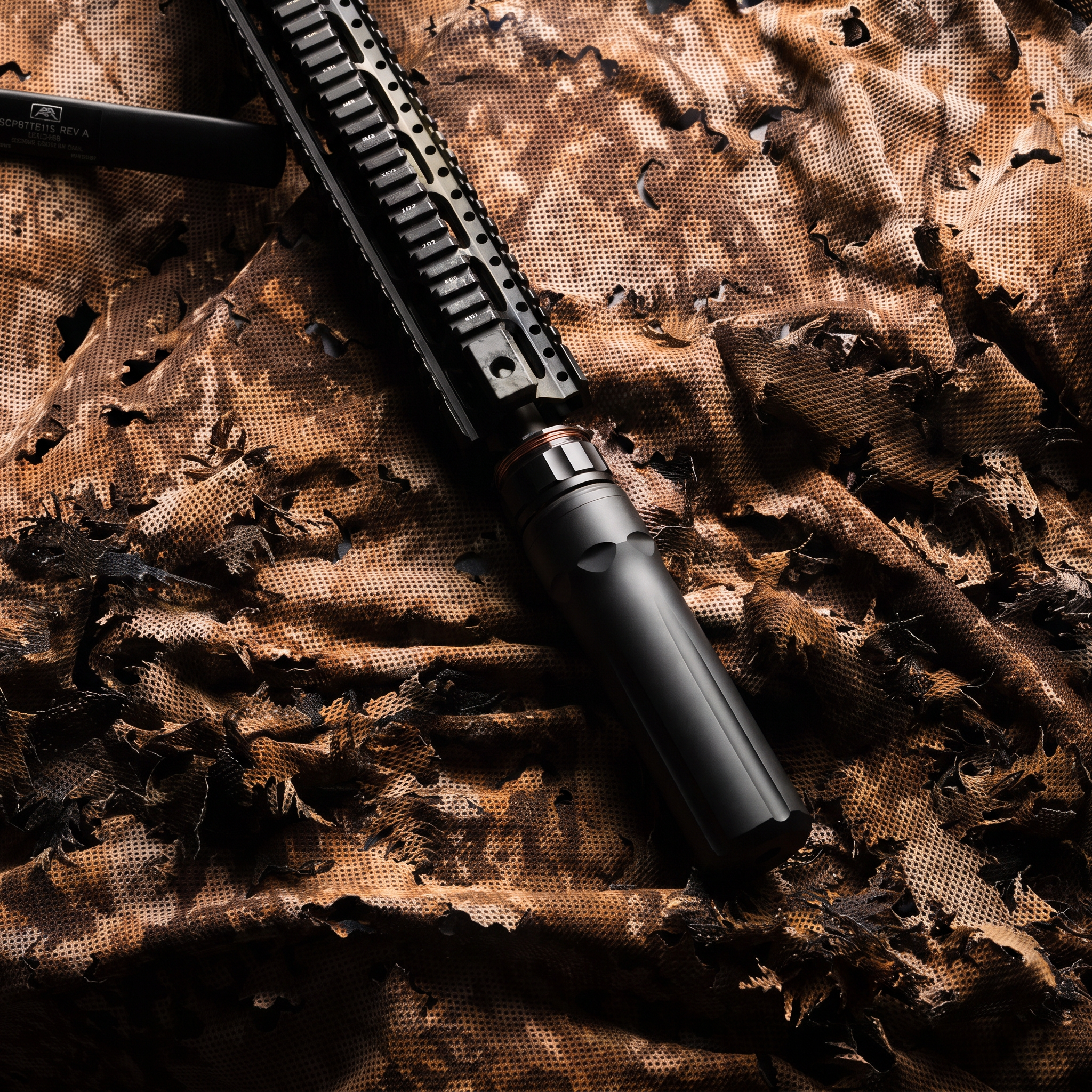
Every Echo Trace suppressor solves a different problem with a different architecture. Tesla-valve gas flow. Six-tube pressure venting. Triangular pyramid baffles. Each is a deliberate engineering choice — not an incremental tweak on a decades-old baffle stack.
In 1920, Nikola Tesla patented a valve with no moving parts — a fixed geometry that lets fluid flow easily in one direction and resist itself in the other. A century later, we adapted it into a coaxial, three-dimensional structure that lives inside the Cloak.
Combustion gas enters the valve and encounters looped internal geometry that redirects it back into the incoming flow. Gas pressure resists itself. The result: high pressure reduction with no gas tubes required — because gas tubes would interfere with the flow system.
Two different Echo Trace answers to the same problem. The Overwatch uses external gas tubes to redirect pressure. The Cloak uses Tesla-valve geometry to make pressure fight itself. Different physics, same goal.
The entrance chamber of any suppressor is the hottest, highest-pressure zone. Traditional cans just let that pressure sit there and hunt for exit — right back through the barrel, into the shooter's face.
The Overwatch uses six external tubes that vent the entrance chamber into engineered cold-spot holding chambers further down the can. Two things happen:
What you feel at the shooter's end: less gas blowback in your face, faster follow-up shots, and a cleaner gun after a range day. What the meter reads: 31.6 dB reduction on .308 — measured on an 18″ DI rifle, January 2026, ±2 dB atmospheric caveat.
Most centerfire suppressors use round or conical baffle cavities. Round baffles flex under blast pressure. Veil doesn't use them.
Triangular baffles aren't new to the category. Veil is built around three-dimensional triangular pyramid baffles — our execution of the geometry, dialed in over three years of iteration. Triangular geometry is the strongest shape in structural engineering: under blast pressure the stress distributes across three planes rather than concentrating on a single curve.
Combined with external gas-tube venting, erosion drops to a fraction of traditional rates. The result: a 5.56 can that runs full auto at 11.5" barrels — the Mk-18 standard — and stays quieter, longer.
Every centerfire model is built from titanium — body, core, baffles, mount. Titanium is lighter than stainless steel, tougher than aluminum, and doesn't fatigue like Inconel under repeated thermal cycling. It's the right material. That's why we use it.
Every Echo Trace suppressor is finished with physical vapor deposition (PVD) or diamond-like carbon (DLC) — coatings applied at the atomic level in vacuum chambers. No Cerakote on our cans. The finish is part of the metallurgy, not a paint layer that can chip off in a heat cycle.
All three centerfire suppressors (Veil, Cloak, Overwatch) use the industry-standard HUB mount (1 3/8-24 threads). That means compatibility with every direct-thread, quick-detach, and flash-hider mount from every major manufacturer. You're not locked into our ecosystem.
BLK or FDE — that's it. Every model, every SKU. No custom Cerakote finishes, no limited runs of neon anodizing. We picked two colors that make sense on 95% of American rifles and stopped there.
Every claim on this page is backed by measured sound data — with the rifle, meter, ammunition, and atmospheric caveats logged. Head to the data page for the full test methodology.